Prospect Fencing Supplies
Standish, Wigan, WN6 0QPMon to Fri 8am to 6pm, Sat and Sun 9am to 2pm
07840 349 621

Family-run. Local install, nationwide supply.

Commercial Security Gates, Manual and Automated

Swing, cantilever sliding, tracked and bi-folding gates for commercial and industrial sites, with infill matched to your perimeter. Installed across Wigan, Greater Manchester and Lancashire. Supply only delivered UK-wide.

Manual or automated
Access control options
Free site survey
Handover documentation
★★★★★Rated 5 stars on Google and Facebook
Free site survey

Request a free gate quote

Opening width, site postcode, and whether you want manual or automated.

Rated 5 stars on Google and Facebook
Free site survey and no-obligation quote
Supply only or supply and install
Fully insured, in-house installers

Manual or automated?

Same product, two very different jobs. Here's how to tell which one you need.

Manual gates suit lower traffic access points. A properly built swing or sliding leaf, drop bolts into ground sockets, a decent lock, and nothing to service. Cheaper to buy, cheaper to own, and it still works in a power cut.

Automated gates suit sites where vehicles come and go all day, where access needs controlling from a gatehouse or office, or where the leaf is simply too heavy to move by hand. They cost more and they need power run to them.

Not sure which way to go? Send us the opening width and how often it gets used, and we'll tell you straight.

Gate types, and what actually decides the choice

Usually the site decides, not preference. Run-back space, gradient, headroom and traffic frequency narrow it fast.

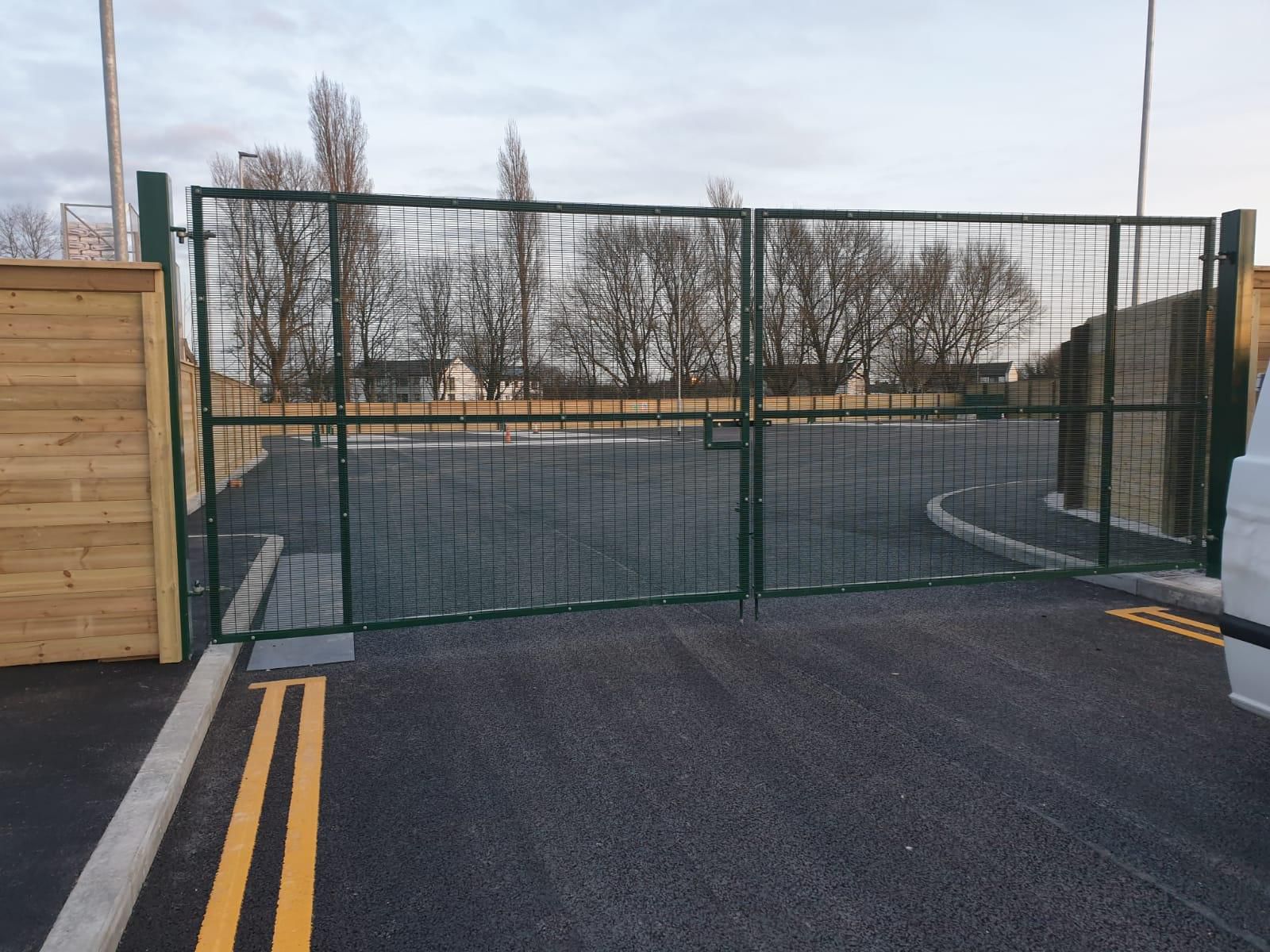
Double-leaf swing security gate at a commercial entrance
Swing

Single and double-leaf swing

Hinged and swinging through an arc. Single-leaf suits openings from around 3m up to roughly 5m to 6m. Double-leaf covers wider openings, commonly up to around 8m to 10m combined. Both need swing clearance and dislike a gradient at the threshold, because each leaf needs consistent ground clearance right through its arc.
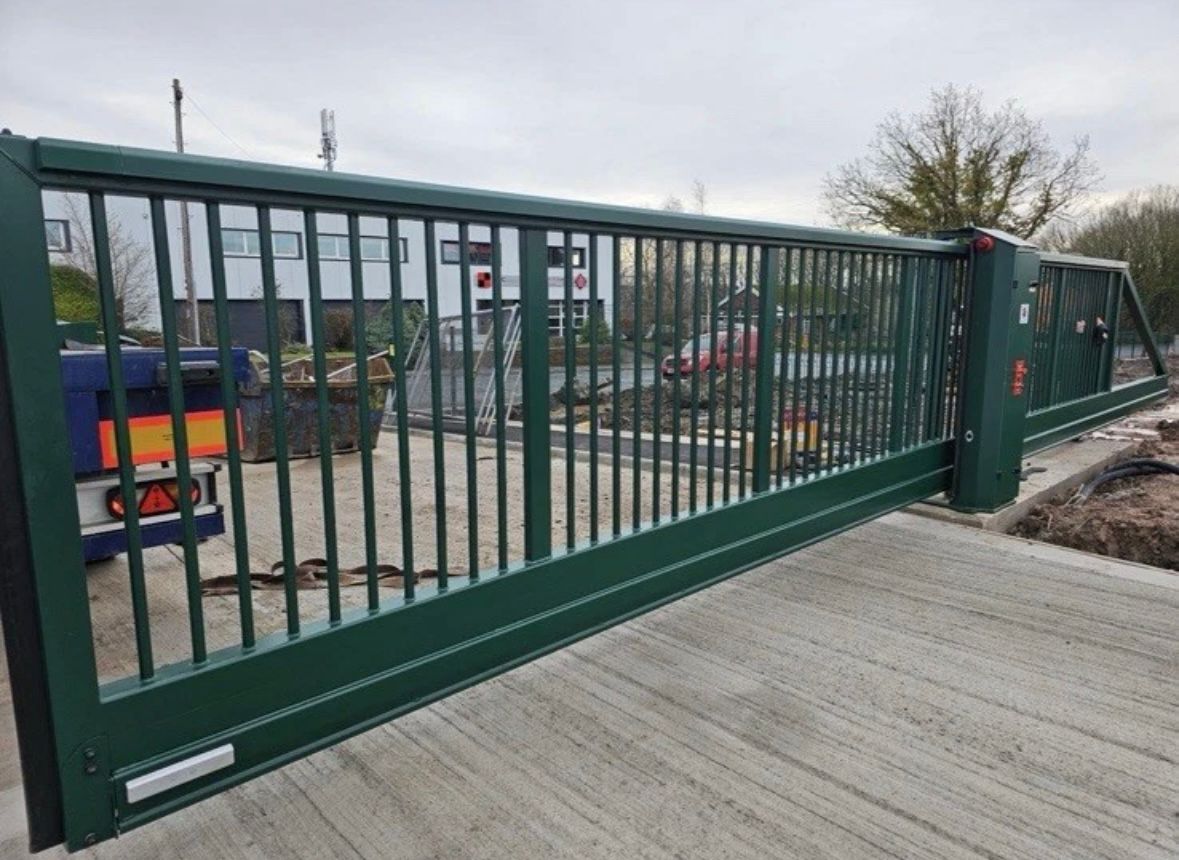
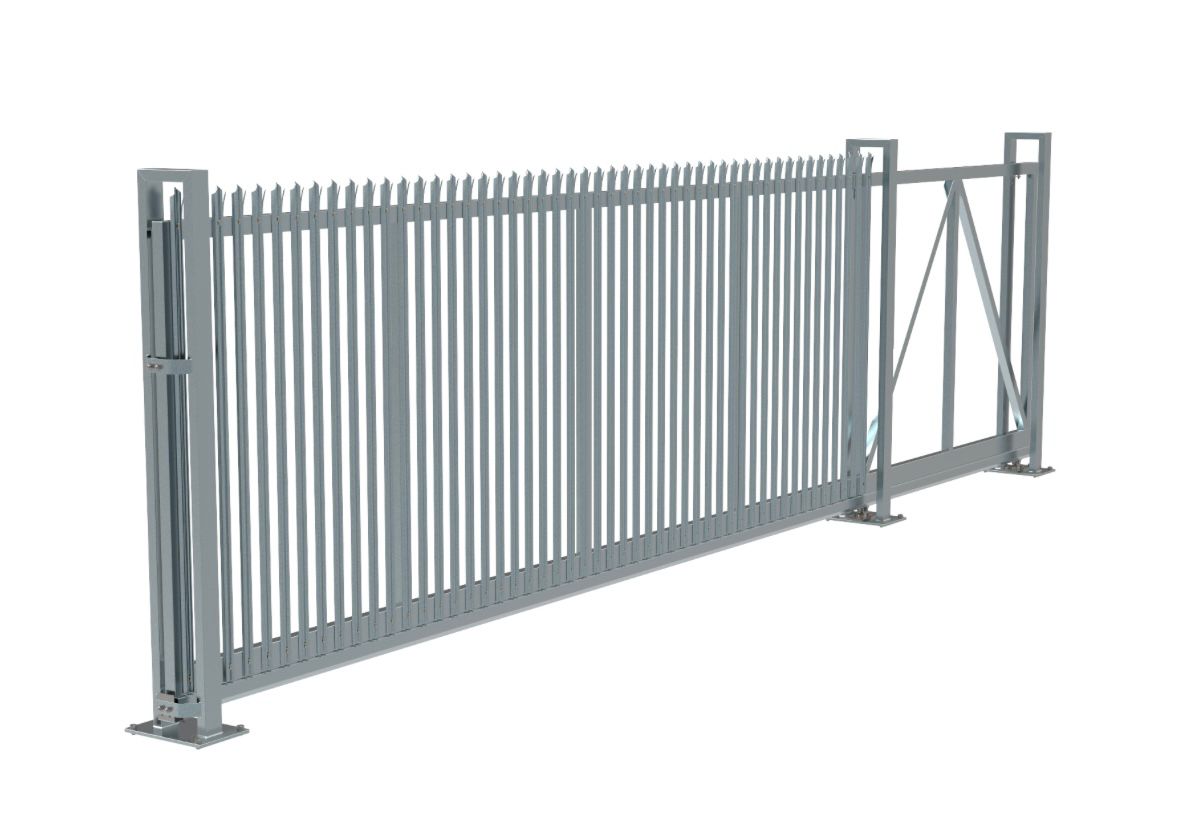
Cantilever sliding gate running on rollers with no ground track
Cantilever

Cantilever sliding

Self supporting on rollers with no ground track. The right answer on uneven ground, on sites with debris or snow, and where heavy vehicles would destroy a track. The catch is run-back: it needs a clear straight run alongside the opening of roughly 1.3 to 1.5 times the clear opening width. No run-back, no cantilever.

Tracked sliding gate running on a ground track at a yard entrance
Tracked

Tracked sliding, bi-folding and telescopic

Tracked sliders can be lighter and cheaper to engineer than cantilever, but need a level, well drained run kept clear of debris and ice. Bi-folding needs roughly half the run-back of a straight slider and cycles faster, which suits tight sites and busy car parks. Telescopic gives a wide opening where run-back is limited.

Infill, matched to your perimeter

A gate should read as part of the fence, not an afterthought bolted into it.

Infill, matched to your perimeter
PalisadeMatches a palisade run, same pale profile and top.
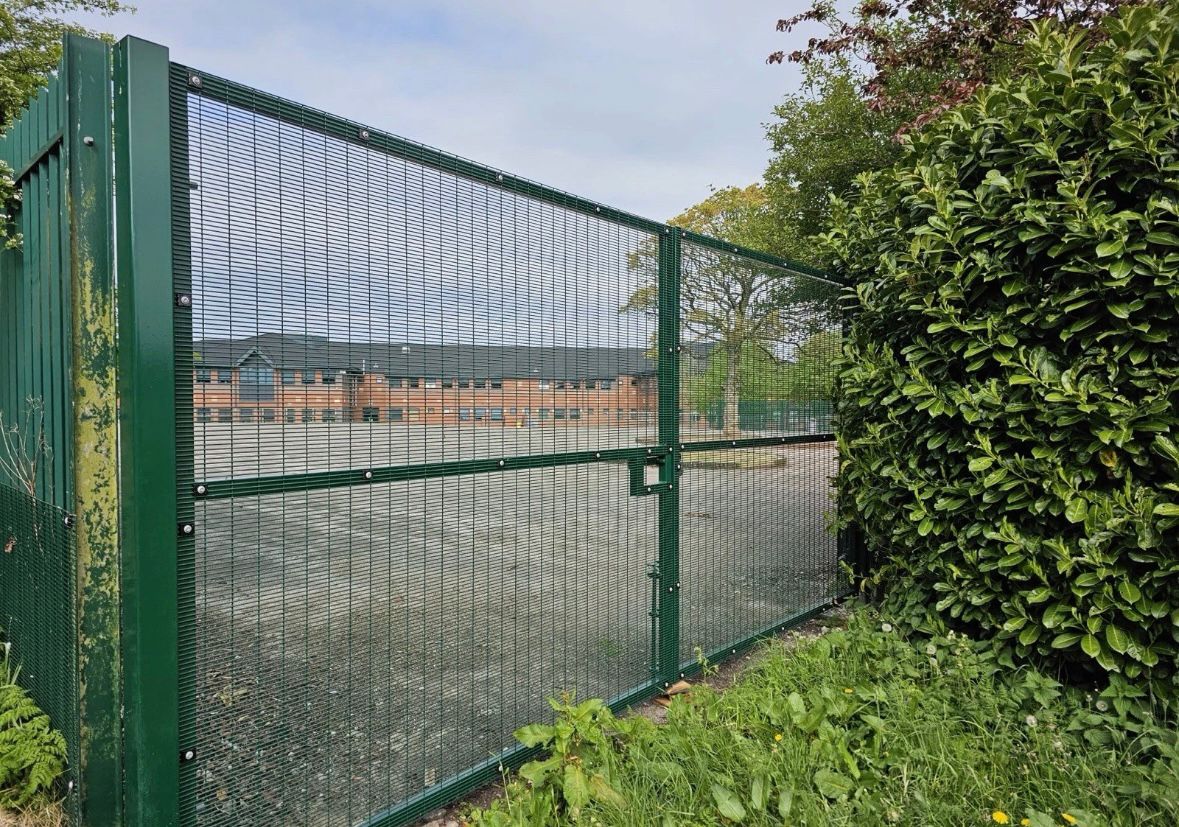
358 anti-climb meshWhere the perimeter is 358 and the gate must not be the weak point.
Twin wire meshMatches an 868 or 656 run.
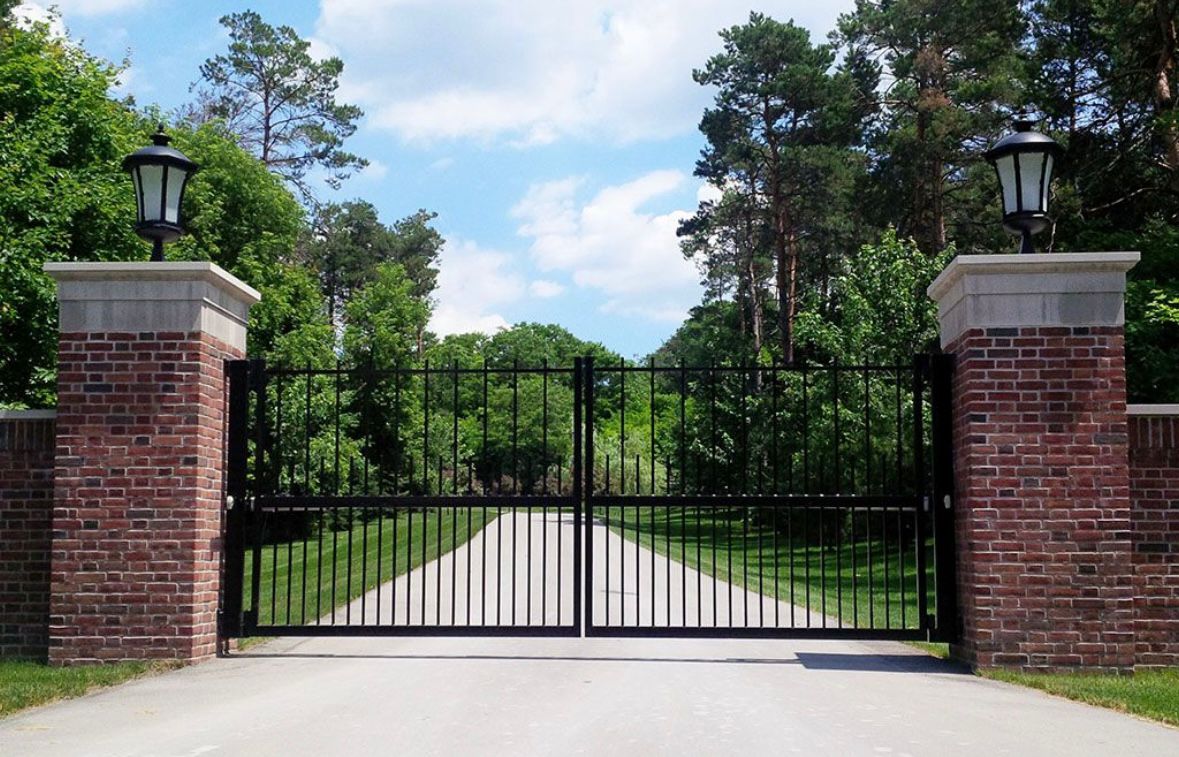
Vertical barFull visibility into the yard, which suits surveillance.
Solid or privacyWhere screening the site matters as much as securing it.
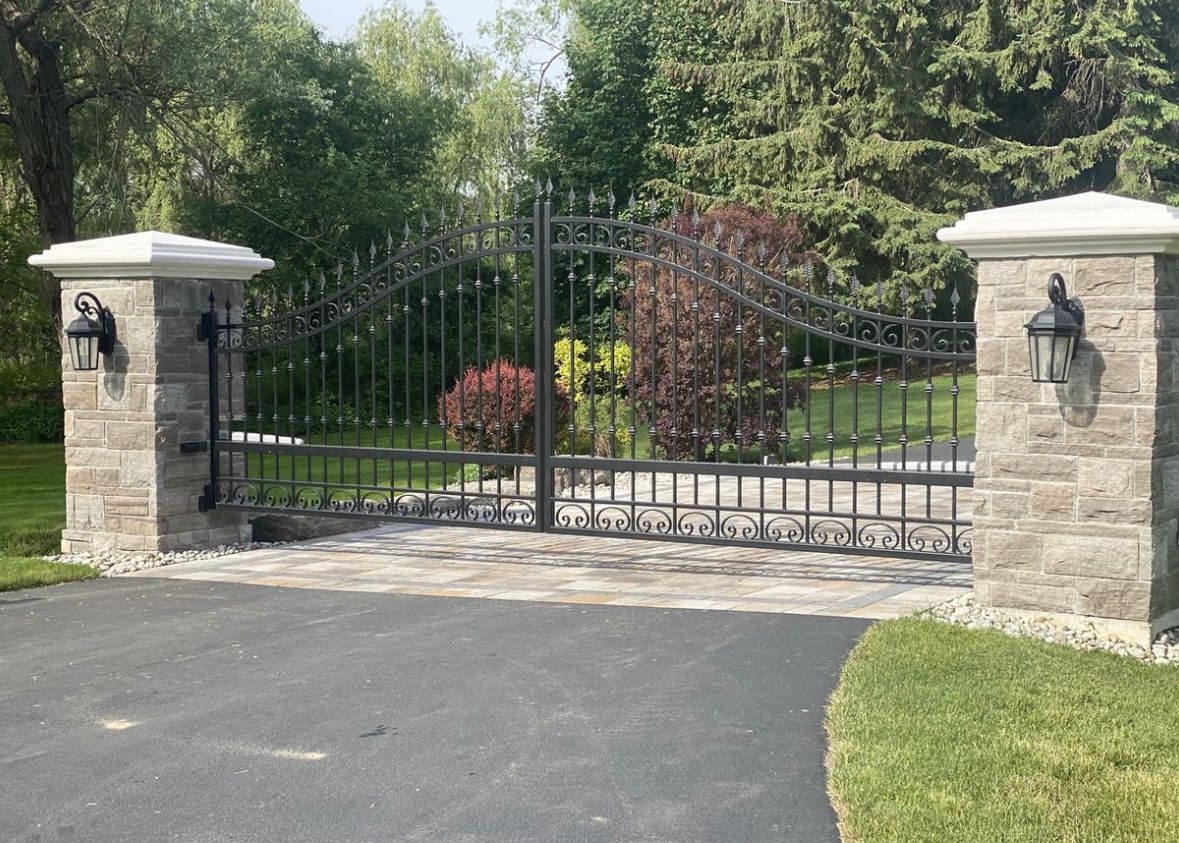
CompositeWhere appearance leads, on business parks and private developments.
Why it is not just a lookA solid leaf presents a continuous surface to the wind where mesh, bar and palisade let it through. That means higher wind loading for the same leaf size, which means heavier posts and foundations, and on an automated gate a motor sized with enough margin to move and hold the leaf safely in a gale. Infill is a specification decision.

Automation and access control

Automation and access control
Swing motorsUnderground rams keep the mechanism out of sight. Above ground articulated arms are easier to get at for servicing.
Sliding motorsRack and pinion drive at the base of the leaf.
Single or three phaseSingle phase 230V covers most commercial entrances. Three phase suits heavier leaves and higher cycle frequency, and needs the supply to be there or run to the gate.
Duty cycleHow much of the time a motor can run before it needs to rest. A busy distribution yard will destroy a motor rated for light domestic use, so cycle frequency is one of the first things we ask about.
Manual releaseA key operated declutch so the gate opens by hand in a power cut or a fault. Not an optional extra.
Battery backupKeeps the gate and its safety devices working through a mains failure. Matters most where the gate is the only way in and out.
Soft start and stopRamps the motor instead of slamming to full speed. Less mechanical stress, and it contributes directly to meeting the force limits.
Access controlKeypads for small teams. Fobs and proximity readers where you need per user access you can revoke and an audit trail. Intercom and video intercom to vet visitors. ANPR to open for known vehicles and stop queuing. GSM and app control where nobody is on site to manage access.
LoopsLoop detectors and free-exit loops set into the surface, both to open for an approaching vehicle and, critically, as a safety device that holds the gate open or stops it closing while a vehicle is in its path.

Manual gate hardware

Drop bolts into ground sockets to hold a leaf closed or open, sized hinges that match the leaf weight and wind loading rather than the catalogue default, and locking to suit how often and by how many people the gate gets opened: padlock hasp, euro cylinder, slam lock or keyed drop bolt. Where security is the point, a shrouded or armoured padlock guard over the hasp is a cheap upgrade that defeats bolt croppers.

Where these go

  • Commercial entrances. One controlled way in and out.
  • Industrial estates and depots. Vehicle access with overnight security.
  • Business parks. Shared entrances for multi let developments.
  • Private developments. Controlled resident and visitor access.
  • Warehouses and distribution. High frequency vehicle traffic, which drives the duty cycle.
  • Loading and goods in bays. Faster cycling gate types earn their cost here.
  • Staff and visitor car parks. ANPR and free-exit loops stop queuing at the barrier.
  • Schools. Controlled pedestrian and vehicle access alongside child safety.

Supply only, or supply and install

Supply and install

Survey, supply and install within roughly 20 miles of Standish: Wigan, Chorley, Buckshaw Village, Leyland, Coppull, Preston, Bolton, Skelmersdale and the surrounding parts of Greater Manchester and Lancashire.

Supply only, delivered UK wide

Gates fabricated to your opening and delivered anywhere in the UK. Note that on an automated gate, whoever puts the finished installed gate into service carries the responsible person duties described above, so if you are installing it yourself, make sure you know what that means before you order.

Recent installations

Gates we have supplied and installed for commercial and industrial sites.

Steel security gate at a commercial entrance
Security gates fitted to a site entrance
Sliding security gate at an industrial yard
Automated cantilever sliding gate
Bespoke double leaf steel gates
Bespoke steel gates made to the opening

What drives the price

Fencing is priced by the metre, and the figure moves with the job. Four things decide it:

  • Clear opening width, because that decides the gate type before anything else
  • Manual or automated, and the duty cycle the motor has to cope with
  • Infill choice, which changes wind loading and therefore posts, foundations and motor size
  • Access control and groundworks, including power to the gate and any loop detectors

Tell us those and we can give you a real number rather than a guess. Site surveys are free and there is no obligation. We will confirm in writing what safety documentation comes with your gate.

How it works

Four steps from first message to a finished job.

Send your sizes or book a free site survey

Run length, height and the site postcode is enough to start.

We measure and confirm the spec

We look at the ground, the access and the risk rather than guess at it.

Written quote

Specification, quantities and a realistic programme, in writing, with no obligation.

Booked in for supply or install

We agree a date and phase the work so your site keeps running.

What our customers say

★★★★★
Security fencing for our business premises turned up on time and went in perfectly. Five stars for product and service.
John P.Bolton · Facebook

Rated 5 stars on Google and Facebook

Every review on this page is a real one from a customer in the North West. You can read the rest for yourself.

Read our reviews

Frequently asked questions

Including the safety and compliance questions most suppliers skip.

Swing gates need clear space for the leaf to travel through its arc and do not like a gradient at the threshold. Sliding gates run along the fence line instead, which suits tight approaches, sloped ground and heavy vehicle traffic. Cantilever sliding needs run back space of roughly 1.3 to 1.5 times the opening width. It is usually the site that decides, not preference.

Yes. Once motorised a gate is legally machinery under the Supply of Machinery (Safety) Regulations 2008. The finished installed gate needs a technical file, a Declaration of Conformity, UKCA or accepted CE marking and user instructions, and it must meet BS EN 12453 in use.

Force limitation plus safety devices. BS EN 12453 caps the force a gate may apply, and whichcap applies depends on the gap: 400N where part of the body could be crushed, 1400N wherethere is impact but no crushing risk, with the force falling to 150N within three quartersof a second either way. Where a gate cannot stay inside those limits on its own, pressure-sensitive safety edges stop and reverse it the moment they touch something. Photocells are asupplementary measure, not a substitute, because a beam can be stepped over.

The site owner or occupier carries a continuing duty to keep it safe under the Workplace (Health, Safety and Welfare) Regulations 1992 and section 3 of the Health and Safety at Work etc. Act 1974. That duty runs for the life of the gate and does not end at handover.

Regular servicing is part of that duty, because motors, hinges, rollers, safety edges and photocell alignment all wear. Frequency should follow the manufacturer's instructions for your installation and reflect how much the gate actually cycles. A busy delivery yard entrance needs checking far more often than a gate used twice a day.

Yes, and on a low traffic access point it is often the sensible choice. Manual swing and sliding gates use drop bolts, ground sockets and padlock or cylinder locking. They avoid the machinery obligations that come with motorising, and there is nothing to service.

Keypads, fobs and proximity readers, intercom and video intercom, ANPR for known vehicles, GSM or app control, and loop detectors including free-exit loops. What suits you depends on how many users you have, whether you need an audit trail, and how much traffic queues at the entrance.

Yes, significantly. Solid or privacy infill catches the wind where mesh, bar and palisade let it through. That raises the wind loading for the same leaf size, which drives heavier posts and foundations, and on an automated gate a larger motor to move and hold the leaf safely.

Cantilever gates span wide openings but need run-back along the fence line of roughly 1.3 to 1.5 times the clear opening. Tracked sliders can work with less run-back but need a level, well maintained track. Telescopic gates give a wide opening where run-back is limited. The available space beside the opening usually decides it.

Sometimes, but it has to be assessed rather than assumed. The existing leaf, posts and foundations were built for a manual gate, and motorising it makes it a machine that must meet BS EN 12453. We will survey it and tell you honestly whether it can be done safely or whether a new gate is the better spend.

A compliant powered gate installation should hand over a Declaration of Conformity, a riskassessment, the results of any force testing carried out and the user instructions. Tell uswhat your site or your insurer needs and we will confirm in writing, before you order,exactly what will be provided with your gate.

Request a Free Gate Quote

Tell us the opening width, the site postcode and whether you want manual or automated, and we will come back with options and a written quote.

Prefer to talk it through?

07840 349 621WhatsApp us[email protected]

Mon to Fri 8am to 6pm. Sat and Sun 9am to 2pm.